SWISHLINE UK: NBA Betting Odds and Strategies for Punters
 Available in US
Table of Contents
- UK NBA Betting Markets: Odds, Spread and Prop Bets Analysis
- Is NBA Betting Legal in the UK?
- How NBA Odds Work for UK Punters
- Core NBA Bet Types Explained
- NBA Game Times in the UK: What to Expect
- How to Place Your First NBA Bet
- NBA Betting Strategies for Beginners
- Responsible Gambling: Staying in Control
- Frequently Asked Questions
- From First Bet to Informed Punter
Data-driven NBA picks for the UK bettor.
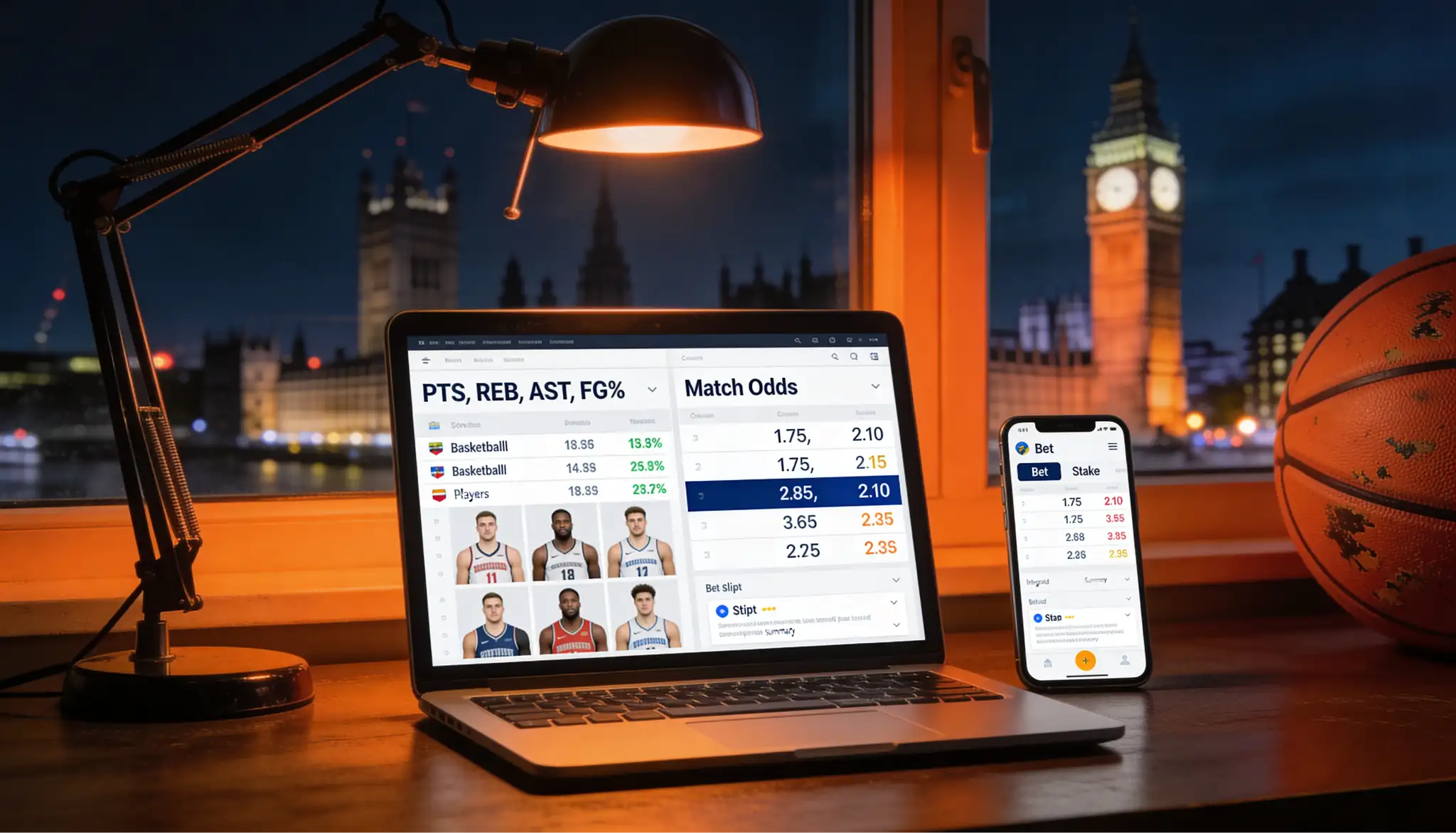
Three years ago, I stayed up until 4am watching the Celtics dismantle the Mavericks in a regular-season game that meant nothing to anyone except me and my betting slip. The spread had moved two points in the final hour before tip-off, and I’d caught it late. That night cost me sleep and £50 – but it taught me more about NBA betting from Britain than any guide I’d read up to that point.
The NBA has evolved from American curiosity to global phenomenon over recent years, capturing the imagination of British sports fans in ways few might have predicted a decade ago. And with that attention comes a growing appetite for putting money where the analysis leads. Ten percent of the UK population now actively participates in online sports betting, feeding a market that generated £16.8 billion in gross gambling yield in 2025 alone. Basketball isn’t football – it’ll never dominate the British betting landscape – but that’s precisely what makes it interesting. The NBA offers markets, rhythms, and opportunities that differ fundamentally from what most UK punters experience with Premier League wagering.
Here’s the reality: betting on NBA from Britain presents unique challenges that American-focused guides simply ignore. The time zones wreck your sleep schedule. The odds formats differ from what you’ll see on US broadcasts. The regulatory framework – UKGC licensing, financial checks, statutory levies – creates an environment nothing like the Wild West of American sports betting. I’ve spent nine years navigating these waters, tracking spreads at midnight, converting American odds to decimals on the fly, and learning when the juice isn’t worth the squeeze.
This guide covers what you actually need to know: the legal landscape specific to UK punters, how to read and calculate odds in formats that make sense here, the core bet types that form the foundation of any NBA wagering approach, and strategies that account for the realities of betting on American sport from across the Atlantic. We’ll get into the specifics of why games starting at midnight matter for your betting decisions, how the 2025 UKGC reforms affect you directly, and what realistic returns look like when you strip away the marketing hype.
UK NBA Betting Markets: Odds, Spread and Prop Bets Analysis
- NBA betting is fully legal through UKGC-licensed bookmakers, with new 2025 regulations introducing financial vulnerability checks for deposits exceeding £150 monthly and a statutory levy funding £100 million annually for responsible gambling initiatives.
- The five core bet types – moneyline, point spread, totals, player props, and parlays – each serve different strategic purposes, with spreads and totals offering more consistent value than backing heavy favourites outright.
- UK bookmakers display decimal odds by default, making potential returns immediately visible: a £10 bet at 2.50 returns £25 total, including your original stake.
- Most NBA games tip off between midnight and 3am GMT, fundamentally shaping which markets work best for British punters and why pre-game analysis often outperforms live betting for those who value sleep.
- Professional bettors target a 53-55% win rate, translating to just 3-5% return on investment across a full season – anyone promising more is selling fantasy.
Is NBA Betting Legal in the UK?
Let me settle this immediately: yes, betting on NBA games is completely legal in the United Kingdom, provided you’re using operators licensed by the UK Gambling Commission. I’ve placed thousands of NBA bets over the years, and not once has the legality been a concern – the regulatory framework here is mature, well-enforced, and frankly among the strictest in the world.
The UKGC operates with a clear mandate: “We exist to safeguard players and the wider public by ensuring gambling is fair and safe.” That’s not marketing fluff. The Commission has genuine teeth, revoking licences, issuing substantial fines, and shutting down operators who fail to meet standards. Unlike some jurisdictions where sports betting exists in legal grey areas, the UK provides certainty. If your bookmaker holds a UKGC licence, your bets are protected under British law.
The 2025 reforms marked a decisive shift in how the UK approaches gambling regulation. A statutory levy, effective from October 2025, now generates £100 million annually for research, prevention, and treatment of gambling harms. This levy falls on operators, not punters – you won’t see deductions from your winnings – but it signals the regulatory direction clearly. The UK is positioning itself as a global leader in responsible gambling regulation, and NBA bettors operate within that framework whether they think about it or not.

How to verify a bookmaker is UKGC licensed
Every licensed operator must display their licence number, typically in the footer of their website or app. Cross-reference this against the UKGC’s public register, which lists all active licences. Look for the Commission’s logo, but don’t rely on it alone – unlicensed operators have been known to display fake badges. The register is definitive.
Financial vulnerability checks now apply to anyone with net deposits exceeding £150 per month, down from £500 before February 2025. These checks don’t necessarily block your account – they’re designed to identify whether your betting activity might indicate financial stress. In practice, you might be asked to provide documentation, and there may be temporary restrictions while verification completes. It’s an inconvenience that exists because problem gambling causes real harm, and regulators have decided that friction is an acceptable trade-off.
Warning about unlicensed operators
Offshore bookmakers sometimes target UK punters with promises of better odds or no verification requirements. Avoid them entirely. Without UKGC licensing, you have no recourse if they refuse payouts, your funds aren’t protected, and you’re potentially breaking the law by using their services. The marginal benefits never outweigh the fundamental lack of protection.
The regulatory landscape continues to evolve. The Gambling Act review, ongoing since 2020, has produced incremental reforms rather than wholesale changes, but the direction favours tighter controls and enhanced player protection. For NBA betting specifically, none of the recent reforms have restricted which markets you can access or how you can bet – basketball remains fully available across all standard bet types. The changes focus on harm prevention mechanisms rather than limiting what you can wager on.
How NBA Odds Work for UK Punters
I spent my first six months of NBA betting converting every price manually because I couldn’t shake my familiarity with American odds from US broadcasts. What a waste of time. UK bookmakers default to decimal odds for excellent reasons, and learning to think in decimals rather than constantly translating will make your betting life substantially easier.
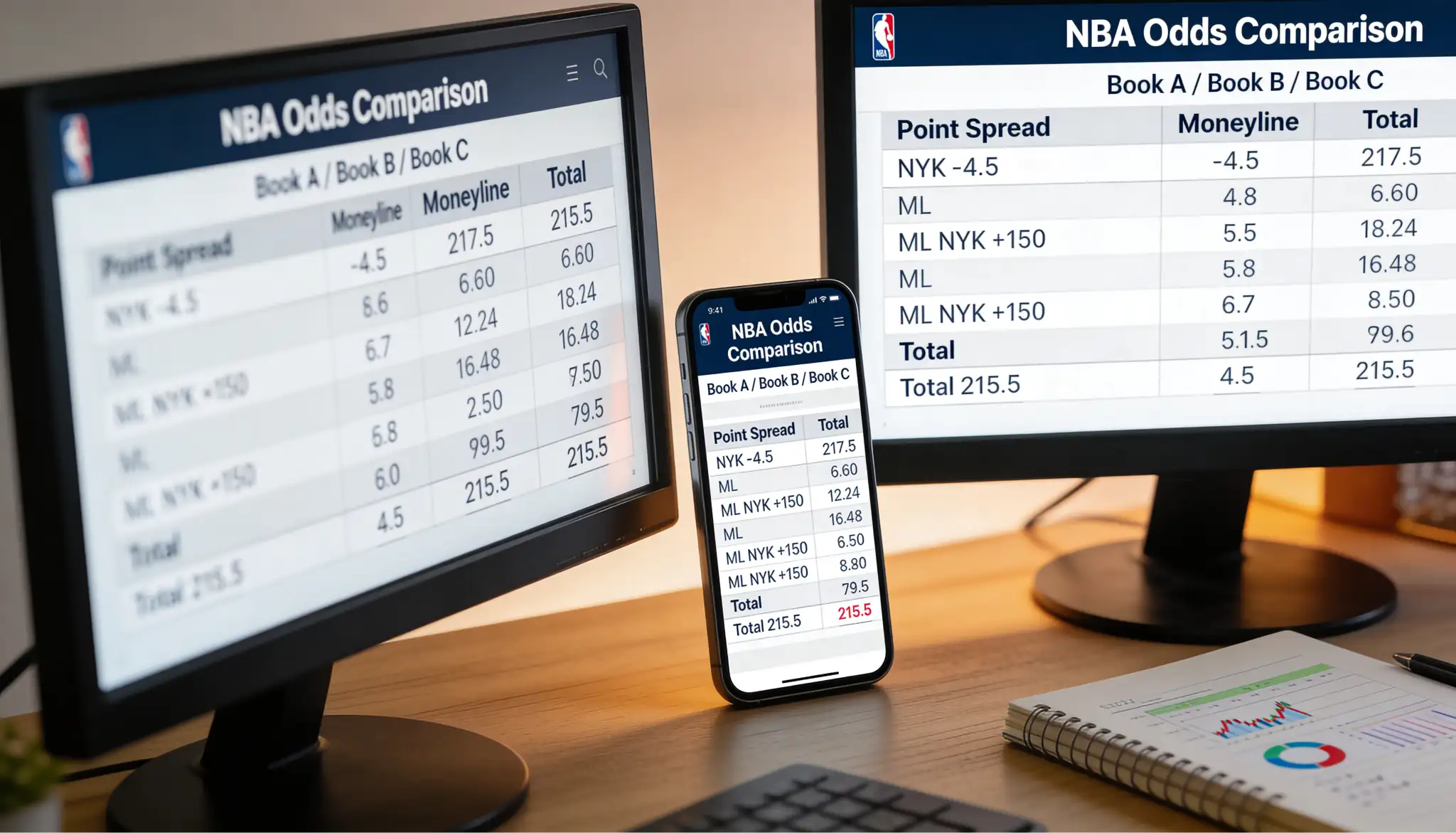
Decimal odds represent the total return on a winning bet, including your stake. Place £10 at decimal odds of 2.50, and a winning bet returns £25 – your original £10 plus £15 profit. The simplicity is the point. Want to know your potential profit? Multiply your stake by the odds, then subtract your stake. Want to compare two different prices quickly? Higher decimal number equals better value. That’s it.
Decimal vs American: The Same Price, Two Formats
| American Odds | Decimal Odds | £10 Bet Returns |
|---|---|---|
| -110 | 1.91 | £19.10 |
| +150 | 2.50 | £25.00 |
| -200 | 1.50 | £15.00 |
| +300 | 4.00 | £40.00 |
| -150 | 1.67 | £16.70 |
American odds dominate NBA coverage because most content originates from the States. Negative numbers indicate how much you must bet to win £100; positive numbers show how much you win from a £100 stake. A team at -150 requires a £150 wager to profit £100 (returning £250 total). A team at +150 returns £150 profit on a £100 stake (£250 total). Both formats express the same information – decimal just does it more intuitively for anyone who didn’t grow up with American conventions.
Converting American to Decimal
For negative American odds: divide 100 by the number (ignoring the minus sign), then add 1.
Example: -110 becomes (100 ÷ 110) + 1 = 0.909 + 1 = 1.91
For positive American odds: divide the number by 100, then add 1.
Example: +250 becomes (250 ÷ 100) + 1 = 2.5 + 1 = 3.50

The margin – also called juice, vigorish, or vig – represents the bookmaker’s built-in profit. In a perfectly even contest, both sides would theoretically be priced at 2.00 decimal (implying a 50% probability for each outcome). Instead, you’ll typically see both sides at 1.91 or similar, reflecting approximately a 4.5% margin. That gap between theoretical fair odds and offered odds is how bookmakers guarantee profit regardless of the outcome.
Seeing the Margin in Action
| Selection | Decimal Odds | Implied Probability |
|---|---|---|
| Team A to win | 1.91 | 52.4% |
| Team B to win | 1.91 | 52.4% |
| Total | 104.8% | |
The 4.8% above 100% represents the bookmaker’s margin. In a “true” market, probabilities would sum to exactly 100%.
Understanding implied probability helps identify value. Convert decimal odds to implied probability by dividing 1 by the decimal and multiplying by 100. Odds of 2.50 imply a 40% chance (1 ÷ 2.50 × 100). If your analysis suggests the actual probability exceeds the implied probability, you’ve found potential value. Whether that value holds over the long run depends on the accuracy of your analysis – but you can’t even begin to assess it without understanding what the odds are telling you.
UK bookmakers often offer slightly different prices on the same NBA game. Margins vary between operators, and shopping for the best available price compounds significantly over hundreds of bets. A consistent 0.05 improvement in odds sounds trivial until you calculate the cumulative impact across a full season’s wagering. The infrastructure exists – multiple accounts, odds comparison tools – and failing to use it leaves money on the table unnecessarily.
Core NBA Bet Types Explained
Walking into NBA betting without understanding the basic market types is like attempting to follow cricket without knowing what an over is – technically possible, but unnecessarily confusing. Five categories cover the vast majority of what you’ll encounter, and each serves a distinct purpose depending on what your analysis tells you and how you want to express that view.
Parlays – combining multiple selections into a single bet where all legs must win – account for roughly 27% of all bets placed on major US markets. That popularity reflects the appeal of turning small stakes into substantial payouts, but it also reflects how much bettors underestimate the mathematical reality of compounding probabilities. We’ll get to that shortly.
Moneyline
Moneyline – A bet on which team will win the game outright, regardless of the margin. No point considerations, no spreads. Team A beats Team B, your bet wins.
Moneyline betting strips away complexity. You’re picking a winner, full stop. The challenge lies in the pricing: heavy favourites come with decimal odds so low – often below 1.30 – that the potential profit barely justifies the risk. A team priced at 1.20 requires £100 wagered to profit £20. That same team needs to win five consecutive games just to double your money, and one upset wipes out all accumulated profit plus your original stake.
Where moneyline shines is in close matchups where the spread sits at 2-3 points or less. Here, the moneyline prices diverge less dramatically, and backing either side offers reasonable value if your analysis supports it. The narrower the expected margin, the more competitive the moneyline becomes.
Point Spread
Point spread – Also called the handicap or line, this adds or subtracts points from a team’s final score to create a more balanced betting proposition. A team favoured by 5.5 points must win by 6 or more to “cover the spread.”
Point spreads exist because lopsided moneyline odds make one side nearly unbettable. If the Celtics are expected to defeat the Wizards by 12 points, the moneyline on Boston might be 1.10 or worse – no sensible bettor touches that. The spread levels the playing field: backing Boston -11.5 at 1.91 becomes reasonable if you believe they’ll win comfortably.
The half-point matters enormously. NBA games frequently land on key numbers – 3, 5, 7 points – and spreads incorporating half-points eliminate pushes (ties against the spread). I’ve covered point spread betting in depth separately, including line movement, key numbers, and when spreads offer better value than moneylines.
Over/Under Totals
Totals – A bet on whether the combined score of both teams will finish over or under a bookmaker-set number. If the total is 224.5, betting the over wins if both teams combine for 225 or more points.
Totals remove the need to pick a winner entirely. You’re betting on game flow – pace, defensive intensity, shooting efficiency – rather than which side prevails. The NBA’s high-scoring nature creates totals typically ranging from 210 to 240, with variation based on the specific matchup, venue, and pace of the teams involved.
Totals attract sharp bettors because the factors influencing combined scores – pace statistics, defensive ratings, rest days, back-to-back schedules – are quantifiable and publicly available. Oddsmakers know this, which makes totals markets efficient but not impervious to analysis that incorporates data others overlook.
Player Props
Player props – Bets on individual player performance metrics: points scored, rebounds, assists, three-pointers made, or combined categories like points-rebounds-assists. Outcomes are independent of which team wins.
Props shift focus from team outcomes to individual performances, opening markets where specialised knowledge creates genuine edges. If you follow a particular player closely, understand their usage rate, know how they perform against specific defensive schemes, and track their minutes in different game scripts – that knowledge translates directly into betting opportunities that casual observers miss.
The correlation between props and game outcomes creates both opportunity and risk. A star player’s points prop might look attractive, but blowouts mean reduced fourth-quarter minutes. I’ve explored player props strategy in detail elsewhere, including how overtime affects props and which statistical categories offer the most consistent value.
Parlays and Accumulators
Parlay – Also called an accumulator or acca in UK terminology, this combines multiple selections into a single bet. All legs must win for the parlay to pay out, but the odds multiply across selections.
Parlays seduce with their potential payouts. Combining three selections at 1.91 each produces total odds of 6.97 – a £10 stake returns nearly £70 on a successful three-leg parlay. The mathematics, however, work decisively in the bookmaker’s favour. Each leg compounds the margin, and the probability of hitting all selections drops dramatically as you add legs.
Professional bettors largely avoid parlays for a reason: the mathematical disadvantage overwhelms the appeal of big potential returns. That doesn’t make them worthless for recreational betting, but it does mean understanding them as entertainment rather than a path to consistent profit. The mechanics, strategies for smarter construction, and risk management are covered in my guide to accumulator betting.
Which Bet Type Suits Different Situations
| Situation | Best Fit | Why |
|---|---|---|
| Close matchup, strong team preference | Moneyline | Reasonable odds without needing margin coverage |
| Heavy favourite expected to dominate | Point spread | Better value than prohibitive moneyline |
| No view on winner, strong pace opinion | Totals | Removes winner selection from equation |
| Deep knowledge of specific player | Player props | Exploits information asymmetry |
| Small stake, entertainment focus | Parlay | Amplified potential returns (accepting lower probability) |
NBA Game Times in the UK: What to Expect
Nobody warns you about the sleep deprivation when you start betting on American sports from Britain. I learned the hard way during my first NBA season, trying to watch every game I had action on and wondering why my work performance cratered by February. The timing reality shapes everything about how UK punters should approach NBA betting.
Standard NBA tip-offs fall between 7pm and 10:30pm Eastern Time, which translates to midnight through 3:30am in the UK during winter months. Daylight saving differences add further complexity – when the US shifts and Britain hasn’t yet, or vice versa, game times can appear to move by an hour. The practical implication: most NBA action happens while you’re asleep or should be.
Typical NBA Game Times for UK Viewers
Weekday games: Generally tip off between midnight and 3am GMT. Early-start games (7pm ET) hit midnight UK time; West Coast games can run until 4am or later.
Weekend games: Earlier options exist, with some afternoon ET games landing at 6-9pm UK time. Sunday slates often include more accessible start times.
Playoffs and Finals: Primetime games typically start around midnight-1am UK time, with weekend games occasionally shifted earlier.
This schedule reality argues strongly for pre-game betting over live wagering for most UK punters. Unless you’re genuinely prepared to stay awake through West Coast overtime games, your analysis happens before tip-off, your bets go in, and you check results the next morning. It’s less exciting than riding momentum swings at 2am, but it’s sustainable.
NBA Christmas Day games offer UK fans some of the season’s most accessible betting opportunities. The league schedules marquee matchups starting from early afternoon Eastern Time, putting the first game at around 5pm GMT and allowing multiple games during UK evening hours. It’s one of the few occasions when watching your bets unfold happens at a civilised hour.

The timing affects live betting strategy fundamentally. In-play markets offer genuine opportunities when you’re watching closely and can react to developments – injuries, foul trouble, scoring runs – faster than odds adjusters. But that edge evaporates when you’re half-asleep and making decisions with diminished judgment. I’ve made more bad live bets at 3am than I care to count, and eventually learned that setting a hard cut-off time serves my bankroll better than chasing marginal opportunities while exhausted.
Weekend scheduling provides breathing room. Saturday and Sunday slates often include early games that tip off during UK evening hours, making them genuinely watchable without sacrificing sleep entirely. Building your NBA betting around these accessible windows – rather than trying to follow every game – produces better decisions and sustainable engagement across the long regular season.
The 82-game season stretches from October through April, with playoffs extending into June. That marathon demands pacing. Treating every Tuesday night like it requires watching three games you’ve bet on leads to burnout well before the season matters most. Selective engagement, concentrated on high-conviction opportunities at reasonable hours, beats comprehensive coverage that leaves you making decisions while fatigued.
How to Place Your First NBA Bet
My first NBA bet was an unmitigated disaster. Not because I lost – though I did – but because I’d skipped verification, discovered my deposit wouldn’t process, found another bookmaker, rushed through registration, and ended up placing a poorly-considered bet minutes before tip-off just to feel like I’d accomplished something. The actual betting process is straightforward when you’re not sabotaging yourself with impatience.
Eighty percent of sports bettors now place wagers via mobile devices, and that proportion likely skews higher for NBA given the late-night timing. Mobile apps from UKGC-licensed bookmakers offer the same markets as desktop sites with interfaces designed for quick navigation. Downloading the app of your chosen bookmaker before you need it – rather than at midnight when the game you want to bet is minutes from tip-off – eliminates unnecessary friction.
Before Your First NBA Bet
- Confirm your bookmaker holds a valid UKGC licence by checking their licence number against the Commission’s public register
- Complete registration with accurate personal information – discrepancies cause verification delays later
- Submit identification documents proactively rather than waiting for a request when you’re trying to withdraw
- Set deposit limits that align with what you can genuinely afford to lose entirely
- Fund your account with enough to cover your intended first bet plus a small buffer
- Navigate to NBA markets and familiarise yourself with the interface before game time
The verification process exists because the law requires it. Bookmakers must confirm your identity, age, and address before allowing certain activity levels or withdrawals. Submitting a passport or driving licence photo alongside a utility bill or bank statement typically completes the process within hours, sometimes minutes. Waiting until you’ve won and want to withdraw invites frustration – verify early and avoid that entirely.
Finding NBA markets varies slightly between bookmakers, but the structure follows consistent patterns. Basketball sits in the main sports menu, NBA appears as a league within basketball, and individual games display with available markets. Standard markets – moneyline, spread, totals – appear immediately. Player props, quarters, and other secondary markets typically require clicking into the specific game.
Placing a Spread Bet
Step 1: Navigate to NBA, find your chosen game, select the point spread market.
Step 2: Click the selection you want – for example, Boston Celtics -5.5 at 1.91 odds.
Step 3: The selection appears in your bet slip. Enter your stake – say £20.
Step 4: Confirm potential returns: £20 × 1.91 = £38.20 total return (£18.20 profit).
Step 5: Review and confirm. The bet is placed, funds deducted from your balance.
Your bet slip confirms the selection, odds, stake, and potential returns before you commit. This is your last chance to catch errors – wrong team, wrong market, wrong stake amount. The three seconds spent double-checking save the frustration of a misplaced bet sitting locked until the game concludes. Odds can change between adding a selection and confirming; most bookmakers notify you of changes and require re-confirmation.
Once placed, your bet appears in your active bets or open bets section. Settled bets move to history after the game concludes. Some bookmakers offer cash-out options allowing you to close positions early at adjusted values – useful for locking in partial profits or cutting losses, though the offered price always favours the bookmaker compared to letting the bet run to completion.
Start small. Seriously. Whatever you think a reasonable first bet is, halve it. The goal of early bets isn’t profit – it’s understanding the process, learning the interface, and experiencing the emotional reality of having money riding on outcomes. A £5 first bet teaches you everything a £50 bet does, with one-tenth the financial consequence if something goes wrong or your analysis proves flawed.
NBA Betting Strategies for Beginners
A mate of mine – sharp guy, successful in his career – lost £2,000 in his first month of NBA betting. Not because basketball is inherently unpredictable, but because he approached it like a casino game: bet more to win more, chase losses to break even, assume sports knowledge translates automatically to betting success. It doesn’t.
Professional bettors using disciplined NBA betting systems aim for a 53-55% win rate. This usually produces 3-5% ROI across a full season. Let that sink in. The best in the business, with access to sophisticated models and years of experience, target profit margins in single digits. Anyone selling guaranteed winning systems or claiming 60%+ hit rates is either lying, cherry-picking results, or about to experience severe regression to the mean.
The mathematics dictate realistic expectations. At standard -110 American odds (1.91 decimal), you need to win approximately 52.4% of bets just to break even after the margin. Winning 55% generates modest but real profit. Winning 60% consistently would make you one of the most successful sports bettors alive. Calibrate your ambitions accordingly.
Start with moneyline and totals rather than spreads. These markets have clearer outcomes and fewer decision points. Picking a winner or betting over a total requires less precision than nailing whether a team will cover 6.5 points. As your understanding develops and your analysis becomes more sophisticated, spreads open up as a valuable tool – but forcing yourself into the most complex markets immediately invites losses while you’re still learning fundamentals.
Focus on one or two teams rather than betting the entire league. The NBA features 30 franchises playing 82 games each across a six-month regular season. Nobody can genuinely track all of them with the depth required for consistent edge-finding. Specialists outperform generalists. Pick teams you’ll actually watch and study – whether through geographical connection, player fandom, or analytical interest – and know them thoroughly rather than knowing all teams superficially.
Do
- Set a betting bankroll separate from essential finances
- Track every bet in a spreadsheet or dedicated app
- Review your results monthly for patterns and leaks
- Accept losses as part of the process, not personal failures
- Increase stakes gradually only after demonstrated positive results
- Use multiple bookmakers to access the best available odds
Avoid
- Chasing losses with larger bets to “get even”
- Betting every game because you feel you should have action
- Following tipsters blindly without understanding their reasoning
- Increasing stakes after wins due to overconfidence
- Betting on tired analysis late at night
- Ignoring early-season sample size limitations

The concept of value underpins everything. A bet has value when the probability you assign to an outcome exceeds the implied probability in the odds. If you believe the Lakers have a 55% chance of winning and they’re priced at 2.10 (implying 47.6% probability), that’s a value bet regardless of whether it wins. Identifying value requires analysis; capturing value requires discipline. The two aren’t the same.
Bankroll management protects you from variance. Even a 55% edge produces losing streaks – sometimes extended ones. The Kelly Criterion and similar staking methods exist to optimise bet sizing, but the foundational principle is simpler: never bet amounts where a losing streak threatens your ability to continue betting. Most approaches suggest individual bets ranging from 1-5% of your bankroll, with 2-3% being a reasonable middle ground for beginners. I’ve written extensively on protecting your betting budget elsewhere.
(function(){ if(document.getElementById(“nbr-css”)){ return; } var c = “#nbr{–n-ink:#08090C;–n-slab:#131720;–n-rule:#1E2530;–n-text:#E4E8ED;–n-dim:#828C9A;–n-acc:#E8792C;–n-hi:#FFA45C;–n-pos:#4FD18B;–n-neg:#E8635A;–n-mono:ui-monospace,SFMono-Regular,Menlo,Consolas,monospace;–n-sans:-apple-system,BlinkMacSystemFont,’Segoe UI’,Roboto,Arial,sans-serif;color-scheme:dark;background:var(–n-ink);color:var(–n-text);font-family:var(–n-sans);font-size:16px;line-height:1.5;padding:20px 18px 16px;border:1px solid var(–n-rule);border-radius:3px;width:100%;max-width:100%;margin:32px 0;display:block;height:auto;min-height:0;max-height:none;overflow:visible}” + “#nbr *{box-sizing:border-box}” + “#nbr div,#nbr p{margin:0;padding:0}” + “#nbr > div{width:100%;height:auto;overflow:visible;float:none;position:static;display:block}” + “#nbr p,#nbr span{color:inherit}” + “#nbr strong{color:#fff;font-weight:700}” + “#nbr a{color:#FFA45C!important;text-decoration:underline;text-underline-offset:2px}” + “#nbr .n-eye{font-family:var(–n-mono);font-size:10px;letter-spacing:.2em;text-transform:uppercase;color:#FFA45C!important;margin-bottom:7px}” + “#nbr .n-tit{display:block;font-size:19px;line-height:1.2;font-weight:700;letter-spacing:-.01em;color:#fff!important;margin:0 0 6px 0}” + “#nbr .n-lede{color:#828C9A!important;font-size:13.5px;margin-bottom:13px;max-width:74ch}” + “#nbr .n-row{display:grid;grid-template-columns:repeat(4,1fr);gap:9px;margin-bottom:12px}” + “#nbr label{display:block;font-size:11px;font-weight:600;color:#828C9A!important;margin-bottom:4px;line-height:1.25}” + “#nbr input,#nbr select{-webkit-appearance:none;appearance:none;width:100%;background:#131720;color:#E4E8ED;border:1px solid var(–n-rule);border-radius:2px;padding:7px 8px;font-family:var(–n-mono);font-size:13px;line-height:1.2;height:auto;margin:0;outline:none}” + “#nbr select{cursor:pointer;padding-right:20px}” + “#nbr select option{background-color:#131720;color:#E4E8ED}” + “#nbr input:focus,#nbr select:focus{border-color:#E8792C;box-shadow:0 0 0 2px rgba(232,121,44,.28)}” + “#nbr .n-bar{background:#131720!important;background-color:#131720!important;border:1px solid var(–n-rule);border-left:3px solid #E8792C;border-radius:2px;padding:11px 13px;margin-bottom:10px;font-size:13.5px;line-height:1.5;color:#E4E8ED!important}” + “#nbr .n-bar,#nbr .n-bar *{color:#E4E8ED!important}” + “#nbr .n-bar strong{color:#FFA45C!important}” + “#nbr .n-bar.ok{border-left-color:#4FD18B}” + “#nbr .n-bar.ok strong{color:#4FD18B!important}” + “#nbr .n-bar.bad{border-left-color:#E8635A}” + “#nbr .n-bar.bad strong{color:#E8635A!important}” + “#nbr .n-cards{display:grid;grid-template-columns:repeat(4,1fr);gap:1px;background:var(–n-rule);border:1px solid var(–n-rule);border-radius:2px;margin-bottom:10px}” + “#nbr .n-card{background:#131720!important;padding:10px 11px}” + “#nbr .n-cl{font-family:var(–n-mono);font-size:9px;letter-spacing:.1em;text-transform:uppercase;color:#828C9A!important;margin-bottom:5px}” + “#nbr .n-cv{font-family:var(–n-mono);font-size:16px;font-weight:700;color:#fff!important;line-height:1.1}” + “#nbr .n-cv.acc{color:#FFA45C!important}” + “#nbr .n-cv.pos{color:#4FD18B!important}” + “#nbr .n-cv.neg{color:#E8635A!important}” + “#nbr .dynamic-scroll-wrapper,#nbr div[class*=’scroll-wrapper’],#nbr .wp-block-table,#nbr figure.wp-block-table,#nbr .table-wrapper{border:0!important;border-width:0!important;border-style:none!important;outline:0!important;box-shadow:none!important;background:none!important;background-color:transparent!important;border-radius:0!important;padding:0!important;margin:0!important;cursor:auto!important}” + “#nbr table{width:100%!important;border-collapse:collapse!important;border-spacing:0!important;font-size:13px;margin-bottom:10px;background:none!important;background-color:transparent!important;color:#E4E8ED!important;box-shadow:none!important;border:0!important;outline:0!important;cursor:auto!important}” + “#nbr table *{cursor:auto!important;-webkit-user-select:text!important;user-select:text!important;color:#E4E8ED!important}” + “#nbr thead,#nbr tbody,#nbr tfoot,#nbr tr{background:none!important;background-color:transparent!important;border:0!important;border-width:0!important;border-style:none!important;outline:0!important;box-shadow:none!important}” + “#nbr th,#nbr td{background:none!important;background-color:transparent!important;background-image:none!important;border:0!important;border-width:0!important;border-style:none!important;border-color:transparent!important;outline:0!important;box-shadow:none!important;vertical-align:baseline!important}” + “#nbr tbody tr:nth-child(odd) td,#nbr tbody tr:nth-child(even) td,#nbr tbody tr:hover td{background:none!important;background-color:transparent!important}” + “#nbr thead th{font-family:var(–n-mono);font-size:9px;letter-spacing:.1em;text-transform:uppercase;color:#828C9A!important;text-align:right;padding:0 0 7px 6px;font-weight:400;border-bottom:1px solid var(–n-rule)!important;border-bottom-width:1px!important;border-bottom-style:solid!important}” + “#nbr thead th.l{text-align:left;padding-left:0}” + “#nbr tbody td{padding:7px 0 7px 6px;text-align:right;border-bottom:1px solid rgba(130,140,154,.28)!important;border-bottom-width:1px!important;border-bottom-style:solid!important;font-family:var(–n-mono)}” + “#nbr tbody td.l{text-align:left;padding-left:0;font-family:var(–n-sans);font-weight:600}” + “#nbr tbody tr:last-child td{border-bottom:0!important;border-bottom-width:0!important}” + “#nbr tbody tr.hit td{background:rgba(232,121,44,.18)!important}” + “#nbr .n-f{color:#fff!important;font-weight:700}” + “#nbr .n-r{color:#E8635A!important;font-weight:700}” + “#nbr .n-g{color:#4FD18B!important;font-weight:700}” + “#nbr .n-note{font-size:11.5px;color:#828C9A!important;line-height:1.55}” + “@media (max-width:760px){#nbr .n-row{grid-template-columns:1fr 1fr}#nbr .n-cards{grid-template-columns:1fr 1fr}#nbr table{font-size:12px}}” + “@media (max-width:470px){#nbr .n-cards{grid-template-columns:1fr}#nbr .n-tit{font-size:17px}}”; var e = document.createElement(“style”); e.id = “nbr-css”; e.appendChild(document.createTextNode(c)); (document.getElementsByTagName(“head”)[0] || document.documentElement).appendChild(e); })();A hit rate only becomes a return once you run it through the price you are paying. This does that conversion, then asks the harder question: how many bets before your results could confirm the edge rather than just hint at it.
| Win rate | ROI | Season profit | Bets to prove it | Seasons |
|---|---|---|---|---|
| 52,4 % — break-even | +0,08 % | £0 | 3.489.914 | 17.450 |
| 53 % | +1,23 % | +£62 | 16.277 | 81 |
| 54 % | +3,14 % | +£157 | 2.498 | 12 |
| 55 % | +5,05 % | +£252 | 966 | 5 |
| 57 % | +8,87 % | +£443 | 313 | 2 |
The right-hand columns are the uncomfortable part. Proving that a 53 percent hit rate is genuine rather than a lucky run needs roughly sixteen thousand bets — around eighty seasons at this volume. Even a 55 percent bettor needs close to a thousand, which is five seasons of consistent work. That is not an argument against tracking results, which remains the only way to spot obvious leaks. It is an argument against reading much into a good or bad month. A profitable season is entirely compatible with having no edge at all, and a losing season is entirely compatible with having one. The 200-bet sample most punters build in a year sits far below the threshold where those two possibilities separate. Two things follow. First, judge your process rather than your bottom line: whether you had a defensible reason for each selection, whether you took the best available price, whether your stake matched your conviction. Those are observable immediately, unlike the edge itself. Second, notice how sharply the proof requirement falls as the edge grows. Going from 53 to 57 percent cuts the sample needed by a factor of fifty. That is the practical argument for selectivity over volume: a smaller number of genuinely strong positions produces a measurable record far sooner than a large number of marginal ones. The calculation assumes independent bets at a constant price and uses a one-sided ninety percent threshold, so treat the bet counts as an order of magnitude rather than a precise target. More in the guides to finding value and expected value, bankroll management and point spread betting. 18+, UKGC-licensed bookmakers only; BeGambleAware.
Early-season betting deserves particular caution. The first few weeks feature small sample sizes, roster changes still integrating, and last year’s narratives influencing lines more than current form justifies. Markets become more efficient as the season progresses and genuine team quality becomes clearer. Patience in October often pays dividends by February.
Profitable NBA betting combines realistic expectations (3-5% ROI over a full season), disciplined execution (consistent stake sizing, rigorous tracking), and focused expertise (deep knowledge of selected teams rather than shallow coverage of the entire league). The path to success isn’t glamorous – it’s methodical, patient, and built on hundreds of small edges rather than home-run bets.
Responsible Gambling: Staying in Control
I’ve seen betting transform from entertainment to compulsion for people I care about. It happens gradually – the stake sizes creep up, the losses get chased harder, the time spent thinking about bets crowds out other concerns. About 0.3% of adults in England are classified as problem gamblers, with another 2.8% considered at-risk. Those percentages sound small until you realise they represent hundreds of thousands of people experiencing genuine harm.
The UK Gambling Commission’s stated mission – “making gambling safer is at the core of what we do” – reflects regulatory priorities that directly affect your betting experience. Mandatory deposit limits, reality checks, self-exclusion tools, and affordability checks exist because gambling harms are real and prevention requires systemic intervention beyond individual willpower alone.
Support Resources
National Gambling Helpline: 0808 8020 133 (free, 24 hours)
GamStop self-exclusion: register to block yourself from all UKGC-licensed gambling sites
BeGambleAware: information, advice, and support for anyone affected by gambling
Self-assessment matters more than external validation. If you’re betting more than you can afford to lose, spending time gambling that should go to other responsibilities, lying about your betting activity, or feeling unable to stop despite wanting to – those are warning signs that deserve honest evaluation. The line between engaged betting and problem behaviour isn’t always obvious, which makes regular self-reflection essential.
Tools Available on UKGC-Licensed Sites
Deposit limits: Set daily, weekly, or monthly caps on how much you can deposit.
Loss limits: Trigger alerts or restrictions when losses reach specified thresholds.
Session time limits: Reminders or forced breaks after extended betting periods.
Cooling-off periods: Temporary self-exclusion for defined periods.
Permanent self-exclusion: Long-term or permanent blocks on account activity.
Using these tools proactively – before problems develop – is far easier than intervening once behaviour has become entrenched. Setting a deposit limit that matches your actual discretionary budget costs nothing and provides a structural guardrail when discipline wavers. I’ve written a comprehensive guide to responsible gambling resources for UK bettors that covers warning signs, support services, and practical steps for maintaining control.
Frequently Asked Questions
What time do NBA games start in the UK?
Most NBA games tip off between midnight and 3:30am GMT during the regular season. Games scheduled at 7pm Eastern Time (the earliest common start) reach UK screens at midnight; West Coast games starting at 10:30pm Eastern don’t begin until 3:30am in Britain. Weekend games occasionally feature earlier afternoon starts that translate to UK evening viewing, and Christmas Day games are specifically scheduled with international audiences in mind, often beginning around 5pm GMT. During British Summer Time, game times shift an hour earlier relative to UK clocks, but the general late-night pattern remains throughout the October-to-June season.
Is NBA betting legal in the UK?
NBA betting is fully legal in the United Kingdom through bookmakers licensed by the UK Gambling Commission. The UKGC regulates all commercial gambling in Britain, and operators must obtain and maintain valid licences to offer services to UK customers. This regulatory framework provides consumer protections including segregated funds, dispute resolution procedures, and requirements for fair terms. Unlicensed operators offering services to UK residents operate illegally, and using them leaves you without regulatory protection. Verify any bookmaker’s licence status through the UKGC’s public register before depositing funds.
How do NBA odds work in the UK?
UK bookmakers display NBA odds in decimal format by default, though American odds appear in much US-focused content. Decimal odds show your total return including stake: odds of 2.50 on a £10 bet return £25 (£15 profit plus your original £10). To convert American to decimal, divide 100 by the absolute value of negative odds and add 1, or divide positive odds by 100 and add 1. So -110 becomes 1.91 decimal, and +150 becomes 2.50. The decimal format simplifies comparison shopping between bookmakers and calculating potential returns without requiring mental gymnastics.
What are the best bets for NBA beginners?
Moneyline and totals offer the gentlest learning curve for new NBA bettors. Moneyline betting simply requires picking the game winner – no point margins to consider. Totals (over/under) remove the need to pick a winner entirely, focusing instead on whether the combined score exceeds or falls below a set number. Both market types have binary outcomes and straightforward logic. Point spreads add complexity through margin requirements, while player props demand deeper statistical knowledge. Start with the simpler markets, and expand your repertoire as your understanding of the game and betting mechanics develops.
How does overtime affect NBA bets?
For most standard markets, overtime counts toward the final result. Moneyline bets include overtime – whoever wins the game, regardless of whether it required extra periods, wins the bet. Spread bets also include overtime; a team covering the spread after regulation and overtime combined satisfies the bet. Totals include all overtime scoring, which is why totals in games going to overtime often sail over. The exception is quarter-specific and half-specific betting, where overtime typically doesn’t count toward those period-based results. Player props generally include overtime statistics, though bookmakers vary slightly – check the specific terms if a game appears headed for extra periods.
Do I need to pay tax on NBA betting winnings in the UK?
No. Gambling winnings in the United Kingdom are not subject to income tax or capital gains tax. This applies regardless of the amount won or the frequency of your betting. The tax burden falls entirely on bookmakers, who pay various levies and duties on their revenues. You can win any amount from NBA betting – or any other form of gambling – and keep the entire sum without reporting it to HMRC or paying tax on it. This differs significantly from many jurisdictions, including the United States, where gambling winnings are taxable income above certain thresholds.
Can I bet on NBA games using my mobile phone?
All major UKGC-licensed bookmakers offer mobile betting through dedicated apps for iOS and Android, as well as mobile-optimised websites. The functionality mirrors desktop platforms, with full access to NBA markets, live betting, account management, and deposits/withdrawals. Approximately 80% of sports betting now occurs on mobile devices, and bookmakers have invested heavily in app performance and user experience. You can place bets, track live games, cash out positions, and manage your account entirely from your phone. Given NBA game times in the UK, mobile betting allows you to place pre-game bets from bed without needing to stay awake at a computer.
From First Bet to Informed Punter
Nine years of NBA betting from Britain has taught me that success looks nothing like the narratives suggest. There are no secret systems, no guaranteed approaches, no shortcuts around the fundamental requirement of doing the work consistently over time. What exists instead is a framework: understand the markets, respect the mathematics, know your edges, and protect your bankroll from the variance that inevitably comes.
The UK offers a uniquely regulated environment for this pursuit. UKGC licensing provides protections American bettors lack. Tax-free winnings mean your profits remain your profits. The infrastructure of mobile betting, multiple bookmaker access, and competitive odds creates genuine opportunity for those willing to approach it seriously.
Your next steps depend on where you are. Complete beginners should focus on understanding odds, placing small bets, and experiencing the process before optimising anything. Those with basic comfort should explore the specific market types that interest them – point spread betting for those drawn to margin analysis, player props for statistical deep-divers, live betting for those who thrive on in-game reads. Everyone benefits from solid bankroll management principles, regardless of preferred markets.
The NBA season offers roughly 1,300 regular-season games plus playoffs – more opportunity than anyone can fully exploit. Selectivity beats coverage. Quality analysis beats quantity of bets. Patience beats urgency. These aren’t platitudes; they’re operational principles that separate sustainable betting from eventual bust-outs.

NBA betting from the UK combines accessible markets, strong regulatory protection, and genuine analytical opportunity – but only for those who approach it with realistic expectations, disciplined execution, and continuous learning. The edge exists. Finding it consistently requires work.
Created by the ”how to bet nba” editorial team.